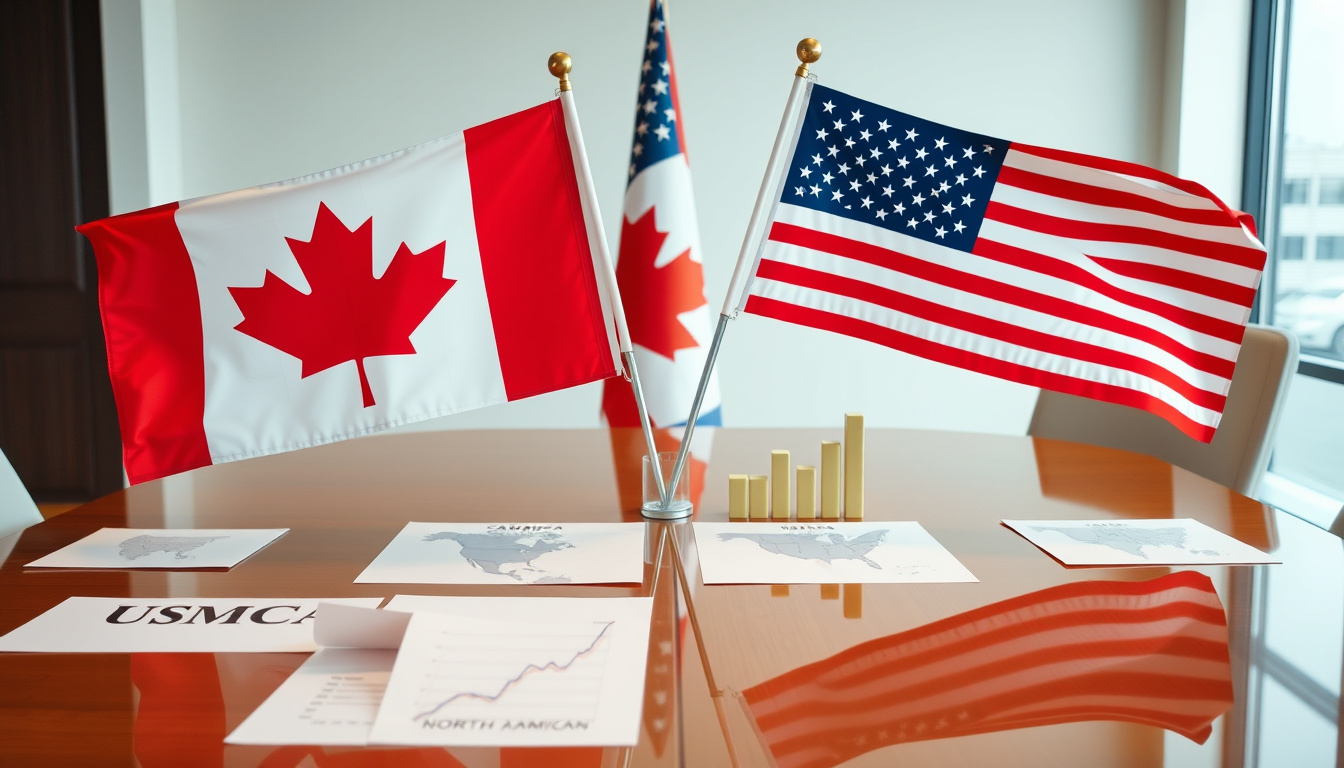
When Prime Minister Mark Carney took office, he inherited a trade relationship under unprecedented pressure. Less than two weeks into his tenure, Carney was already publicly rejecting U.S. demands tied to the continental free trade pact—calling out tariffs that his government says violate the agreement, and refusing to accept what he called an “entry fee” just to sit at the table. The July 1, 2026 deadline for renewing the USMCA is approaching fast, and both sides remain far apart on what a renewed deal should look like.
Tariff-free Canada-U.S. trade: over 85% · USMCA review trigger: scheduled July 1, 2026 · Recent Carney committee: first meeting held this week · Trade war period: 2025–2026
Quick snapshot
- 85%+ of Canada-U.S. trade remains tariff-free under USMCA (Wikipedia)
- USMCA review deadline: July 1, 2026 (Rethink Trade)
- Carney says U.S. “won’t dictate” trade terms (Global News)
- Trump suspended formal talks in October 2025 (YouTube)
- Whether Mexico will accept U.S. demands on energy market access
- Full impact of 100% tariff threats on Canadian exporters
- What “rupture” of the relationship would actually look like
- Whether all three parties will confirm extension by deadline
- Sept. 16, 2025: USTR opened public comment period (Rethink Trade)
- Dec. 16–17, 2025: USTR reported to congressional committees (Rethink Trade)
- Oct. 2025: Trump suspended talks over Ontario ad (YouTube)
- July 1, 2026: Formal review launch — extension or 2036 sunset (CSIS)
The table below summarizes the key data points shaping the USMCA review debate.
| Fact | Value |
|---|---|
| Agreement name (Canada) | CUSMA |
| Agreement name (U.S.) | USMCA |
| Canada-U.S. tariff-free trade | 85%+ |
| PM Carney’s stance | U.S. won’t dictate |
| Trade war period | 2025–2026 |
| Review deadline | July 1, 2026 |
| Extension period if confirmed | 16 years |
| Sunset expiration if not renewed | July 1, 2036 |
| Chinese EVs allowed into Canada | 49,000 |
| Canadian tariff rate on Chinese EVs | 6.1% |
| Trump’s tariff threat on Canada | 100% |
| Next review if extended | 2032 |
What is USMCA?
The United States-Mexico-Canada Agreement governs the biggest trilateral trading relationship on earth, covering roughly $1.3 trillion in goods and services annually. Canadians know it as CUSMA; Americans call it USMCA. Under Article 34.7 of the agreement, all three governments must formally decide by July 1, 2026, whether to extend the pact for another 16 years or allow it to enter a cycle of annual reviews that could end with the agreement expiring in 2036.
Origins of the agreement
The USMCA replaced NAFTA in 2020, negotiated under the first Trump administration as a condition for keeping the continent’s duty-free trade zone intact. The new agreement included updated rules on digital trade, labor mobility, and automotive origin requirements, while maintaining the core architecture that had governed North American commerce since 1994.
As of August 2025, over 85% of Canada-U.S. trade and 84% of Mexico-U.S. trade remained tariff-free thanks to the USMCA exemption (Wikipedia). That figure underscores how consequential the agreement is: even amid open trade war threats, the bulk of cross-border commerce continues without duties.
Key exemptions
The agreement shields most manufactured goods, agricultural products, and energy resources from tariffs—but not all. Steel, aluminum, lumber, and automobiles have all faced separate U.S. duties that Carney’s government argues violate the current pact’s terms.
If all three countries confirm in writing that they want to continue the USMCA, the agreement extends for another 16 years, with the next formal review shifting to 2032 (Prodensa). If even one country declines to confirm, the pact enters yearly reviews, giving all parties a decade to resolve their differences before the agreement expires on July 1, 2036.
The implication is clear: a single “no” triggers a decade-long countdown that could reshape continental supply chains.
The stakes are asymmetric. Extending means 16 more years of predictable access to the U.S. market. Failing to extend—or forcing annual reviews—plants a decade-long clock over every business decision that depends on cross-border supply chains.
What is the current status of Canada-U.S. trade talks?
Formal negotiations have not started. Trump suspended trade talks with Canada in October 2025, reportedly in anger over an advertisement by the Ontario government that criticized U.S. tariffs (YouTube commentary on Carney statement). That pause has persisted into April 2026, leaving the July 1 deadline as the effective forcing function.
Carney’s advisory group meeting
Carney convened his trade advisory committee this week for its first formal session on CUSMA strategy. The committee brings together trade economists, industry representatives, and former negotiators to map Canada’s position ahead of what analysts expect to be an arduous process.
“It’s not the case that the United States dictates the terms,” Carney said publicly (Global News). His chief trade negotiator told the U.S. House Ways and Means Committee that there are “load-bearing pillars” in the agreement working well, but that renegotiation is necessary to address American concerns (Global News).
Review preparations
On September 16, 2025, the U.S. Trade Representative opened a public comment period on the joint review of the USMCA (Rethink Trade). On December 16 and 17, 2025, USTR reported to the House Ways and Means Committee and Senate Finance Committee on the administration’s priorities for review.
The CSIS projects that even in the base-case scenario, negotiations will stretch into late 2026 or beyond, concentrating on autos, energy, China-related disciplines, and enforcement architecture (CSIS analysis). A best-case outcome involves extending the agreement with only small technical updates—perhaps adjustments to digital trade or AI rules—but that outcome requires goodwill that currently appears absent.
What this means for businesses watching this process: the formal deadline does not guarantee resolution.
How has Trump influenced Canada-U.S. trade?
Trump’s approach has been defined by tariff escalation and public pressure. He has imposed duties on steel, aluminum, lumber, and automobiles—measures that Carney’s government says go beyond legitimate trade complaints and violate the current agreement’s terms.
Tariff announcements
Trump has threatened 100% tariffs on Canada, citing the federal government’s EV policy that allows 49,000 Chinese electric vehicles into the country at a 6.1% tariff rate (Responsible Statecraft). Treasury Secretary Scott Bessent accused Carney of “virtue-signaling to his Globalist friends” regarding Canada’s diversification strategy.
Canada has maintained counter-tariffs on imports of automobiles from the United States and is providing reskilling and financial support for laid-off auto workers affected by the tariff regime (Responsible Statecraft).
Trade war context
The tariff conflict has its roots in more than economic policy. Trump ended formal talks with Canada in October 2025 over the Ontario government advertisement mocking U.S. trade actions (YouTube). Formal negotiations have not resumed, leaving the bilateral relationship in a holding pattern as the USMCA review deadline approaches.
U.S. Trade Representative Jameson Greer accused Canada of “doubling down on globalization” by diversifying its trading relationships, and said Canada’s strategy is “at odds with the Trump administration’s trade priorities” (Global News). Greer also warned that unless Canada engaged in talks about broadening rules of origin, Washington might impose additional border controls.
The pattern suggests Washington is using the review process to extract concessions beyond the formal trade pact.
Canada’s EV policy is a flashpoint. Allowing 49,000 Chinese EVs at a 6.1% tariff has given Washington a concrete grievance that goes beyond the abstract case for renegotiation—and Carney shows no sign of reversing course.
What is the trade war between U.S. and Canada?
The 2025–2026 trade war is not a traditional tariff dispute. It is a structural conflict about the terms of economic integration, the role of China in North American supply chains, and whether a continent-scale free trade zone should operate on Washington’s preferred terms or a negotiated balance of interests.
Timeline of tensions
Tensions escalated through 2025. Trump imposed tariffs on Canadian steel and aluminum, then expanded duties to automobiles. The Ontario government’s decision to advertise against U.S. tariffs—framing them as unfair—triggered a presidential reaction that froze formal negotiations. Carney’s election and his decision to refuse preconditions added a new dimension: a Canadian leader willing to contest U.S. demands publicly rather than negotiate quietly.
Under Article 34.7 of the USMCA, the three governments must decide by July 1, 2026, whether to extend the agreement for another 16 years (CSIS). If any party declines to confirm extension, the USMCA enters a cycle of annual reviews, and absent resolution, expires in 2036.
Impacts on trade
Despite the tariff war, over 85% of Canada-U.S. trade remains tariff-free due to USMCA exemptions (Wikipedia). This means the conflict is concentrated in specific sectors—automobiles, steel, aluminum, lumber—rather than threatening the entire trading relationship. But the uncertainty itself is disruptive: businesses delay investment decisions, supply chains hedge against potential tariff expansion, and negotiating partners plan for the worst-case scenario.
Mexico and Canada are expected to make concessions to reduce tariff exposure and extend the agreement, with some concessions being costly—particularly on rules of origin or market access (CSIS).
The catch is that extension may require Canada to accept terms that undermine its diversification strategy.
Extending the USMCA preserves duty-free access but may require Canada to accept stricter automotive rules of origin, constraints on Chinese investment, and commitments on energy policy that limit diversification options. Not extending means a decade-long clock and compounding uncertainty.
What role does Mark Carney play in trade talks?
Mark Carney is the lead Canadian actor in the most consequential trade negotiation the country has faced since NAFTA was replaced. As Prime Minister, he sets Canada’s negotiating posture and chairs the cabinet decisions that will determine how far Canada is willing to move—and what it will not accept.
Statements on negotiations
Carney has been notably blunt in rejecting U.S. preconditions. He said he has “never heard of an entry fee” that Canada would have to pay to start talks with the White House on renewing the continental free trade pact (YouTube (Carney statement)). His language has been consistently assertive: he has described U.S. tariffs on steel, aluminum, lumber, and automobiles as “more than irritants” that violate the current agreement (YouTube (Carney statement)).
Carney used the word “supplicant” to describe how Canada refuses to be positioned in relation to the United States in trade negotiations (YouTube commentary on Carney statement). The framing is deliberate—a signal to domestic audiences and international partners that Canada will not approach the USMCA review from a position of weakness.
“It’s not the case that the United States dictates the terms. We have a negotiation. We can come to a mutually successful outcome.”
— Prime Minister Mark Carney, Global News
“We have load-bearing pillars in CUSMA that are working well, but renegotiation is necessary to address American concerns.”
— Canada’s chief trade negotiator, Global News
Committee formation
Carney assembled a trade advisory committee drawing on economists, former negotiators, and industry leaders. The committee held its first meeting this week to begin mapping Canada’s formal position ahead of the July 2026 review deadline.
The advisory group’s mandate is to develop strategy across multiple fronts: automotive rules of origin, energy market access, China-related disciplines, and enforcement architecture—the same areas the CSIS identifies as the center of likely negotiation friction.
The implication is that Carney is building a coalition to resist U.S. pressure rather than capitulate to it.
Carney’s refusal to accept preconditions has set a clear red line. Whether it strengthens Canada’s hand or hardens U.S. resistance depends on what leverage Canada can muster—and whether Washington prefers a functional North American trade zone to a protracted tariff confrontation.
Timeline
Five events that shaped where the negotiations stand heading into April 2026.
Trump ended trade talks with Canada over Ontario government advertising that criticized U.S. tariffs. Formal negotiations have not resumed.
The U.S. Trade Representative opened a public comment period on the joint review of the USMCA, the formal opening of Washington’s review process.
USTR reported to the House Ways and Means Committee and Senate Finance Committee on the administration’s priorities for the USMCA review.
Carney’s trade advisory committee held its first formal meeting to develop Canada’s negotiating position for the July 2026 review.
Formal USMCA review launch. All three governments must confirm extension in writing, or the agreement enters annual review cycles with a 2036 expiration.
What this means: the deadline is real but not self-enforcing, and negotiations will continue long after the formal trigger date.
The July 1, 2026 deadline is real but not self-enforcing. Even if all three countries confirm extension, negotiations over the terms of any revised agreement will continue long after the formal deadline—and Canada faces the risk of a U.S. administration that may not want a deal at any acceptable price.
What we know versus what remains uncertain
With research confidence rated low, the picture has clear confirmed facts alongside genuine unknowns. Here’s how the landscape breaks down.
Confirmed facts
- Over 85% of Canada-U.S. trade remains tariff-free under USMCA
- USMCA review deadline is July 1, 2026
- Carney’s committee held its first meeting this week
- Trump suspended talks in July 2026 over Ontario advertising
- Canada allowing 49,000 Chinese EVs at 6.1% tariff
- USTR opened public comment period September 16, 2025
- Article 34.7 requires trilateral confirmation for 16-year extension
Unconfirmed or uncertain
- Whether Mexico will accept U.S. demands on energy market access
- Whether Carney’s firm stance will strengthen or weaken Canada’s position
- Whether Trump will follow through on 100% tariff threats
- Whether annual reviews would actually trigger 2036 expiration
- How China’s response to Canadian EV policy will affect negotiations
Related reading: Mark Carney · Trump Tells Cuba to Make a Deal
youtube.com, youtube.com, csis.org, marubeni.com, bakerinstitute.org
The USMCA review process has been shaped by Prime Minister Carney’s direct exchanges with President Trump, as outlined in the Carney-Trump trade negotiations timeline spanning 2025-2026 tensions.
Frequently Asked Questions
When does the USMCA review start?
The formal review process begins on July 1, 2026, when all three governments must confirm in writing whether they want to extend the agreement for another 16 years. If any party declines, the USMCA enters annual review cycles with a potential 2036 expiration.
What tariffs has Trump imposed on Canada?
Trump has imposed duties on Canadian steel, aluminum, lumber, and automobiles—measures that the Carney government argues violate current USMCA terms. He has also threatened 100% tariffs on all Canadian goods in response to Canada’s EV policy allowing 49,000 Chinese electric vehicles at a 6.1% tariff rate.
Why was Carney’s trade committee formed?
Carney convened his trade advisory committee to develop Canada’s formal negotiating position ahead of the July 2026 review deadline. The committee brings together trade economists, industry representatives, and former negotiators to map Canada’s strategy across autos, energy, China-related disciplines, and enforcement architecture.
How much of Canada-U.S. trade is affected by tariffs?
Despite the tariff war, over 85% of Canada-U.S. trade remains tariff-free due to USMCA exemptions. The conflict is concentrated in specific sectors—automobiles, steel, aluminum, lumber—rather than threatening the entire trading relationship.
What is the difference between USMCA and CUSMA?
They refer to the same agreement; Americans call it USMCA (United States-Mexico-Canada Agreement) while Canadians use CUSMA (Canada-United States-Mexico Agreement). The trilateral trade pact replaced NAFTA in 2020 and covers roughly $1.3 trillion in goods and services annually.
Are Canada-U.S. trade talks part of a larger trade war?
Yes. The 2025–2026 period is characterized as a trade war between the U.S. and both Canada and Mexico. The conflict extends beyond traditional tariff disputes to questions about economic integration, China’s role in North American supply chains, and whether the continent’s free trade zone should operate on Washington’s preferred terms.
What are the main goals of the USMCA review?
The review must determine whether to extend the agreement for another 16 years or allow it to enter annual review cycles. Key negotiation areas include automotive rules of origin, energy market access, China-related disciplines, and enforcement architecture. A best-case outcome involves extending with only small technical updates; a base-case involves painful concessions.
The stakes for Canada are enormous: a decade-long clock starts ticking if extension is not confirmed.
Related stories




Jessica Morin covers provincial policy, regional economics and public affairs across Canada.