
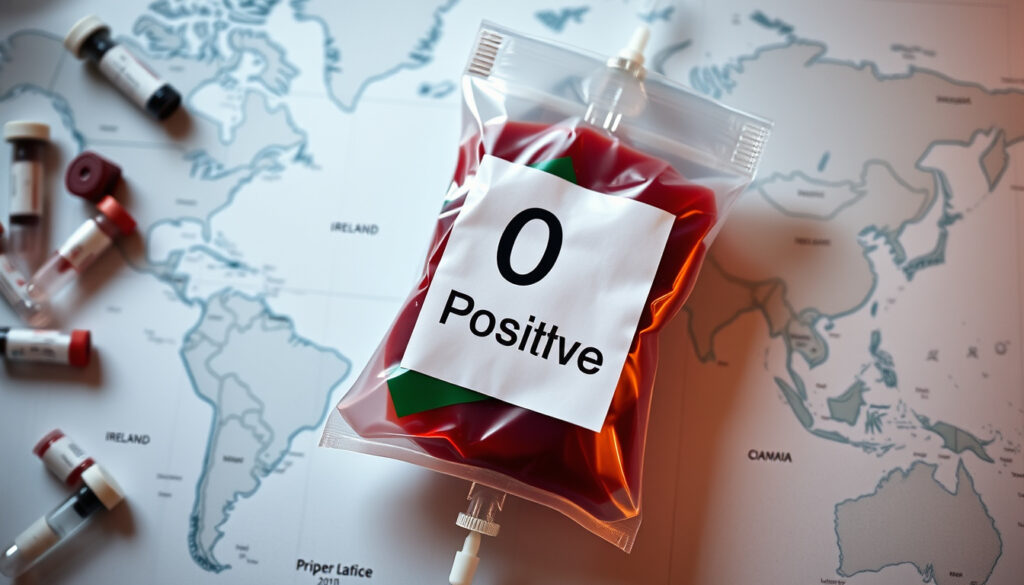
Walk into any Irish hospital and mention blood types, and most staff will finish the sentence for you: O Positive. It dominates here more than almost anywhere else on Earth. This article breaks down exactly how common each blood type is in Ireland, how we compare to the US and UK, and what the science actually says about health correlations that float around online.
Most common in Ireland: O Positive (47%) · Most common in the US: O Positive (37%) · Rarest in Ireland: AB Negative (1%) · Most common globally: O Positive (38.4%) · Universal donor: O Negative · Universal acceptor: AB Positive
Quick snapshot
- O+ leads in Ireland (47%) per Irish Blood Transfusion Service
- AB- rarest in Ireland (1%) per Irish Blood Transfusion Service
- O+ most common in US (37%) per Red Cross Blood Donation
- Health risk links by blood type lack consistent evidence
- Whether COVID-19 susceptibility varies meaningfully by type
- ADHD correlation claims remain unproven at scale
- PMC study (2021) gave modern Ireland ABO snapshot
- Irish Blood Transfusion Service data updated continuously
- Ongoing research into rare blood type genetics
- AB Negative donors remain critically needed per Irish Blood Transfusion Service
- O Negative supply strained by constant emergency demand per Red Cross Blood Donation
- Know your type—donation decisions affect supply chains directly (Irish Blood Transfusion Service)
Six key figures, one pattern: Ireland skews harder toward type O than most countries on Earth, while the rarest type here sits at just one percent of the population.
| Location | O+ | AB− | Total Group O | Source |
|---|---|---|---|---|
| Ireland | 47% | 1% | 55% | Irish Blood Transfusion Service |
| United States | 37% | 0.6% | 44% | Red Cross Blood Donation |
| United Kingdom | 36% | 1% | — | NHS Blood Donation |
| Global average | 38.4% | — | 46% | Wikipedia (compiled) |
What are the 3 most common blood types?
Three types account for the vast majority of blood used worldwide: O Positive, A Positive, and B Positive. The precise rankings shift slightly by country, but the hierarchy holds remarkably steady.
Global distribution
Type O Positive sits on top globally, representing roughly 38.4% of the world’s population (Wikipedia, compiled from multiple national surveys). A Positive comes in as a close second at around 27% globally, with B Positive holding roughly 20% and AB Positive accounting for about 5%. Rh-negative variants (O-, A-, B-, AB-) collectively make up roughly 15% of the global population Medical News Today.
US and UK stats
The Red Cross Blood Donation reports O+ as the most common US blood type at 37%, followed by A+ at 35.7%, B+ at 8.6%, and AB+ at 3.4%. When including negative types, the US total of type O reaches 48% Bloodworks Northwest. The UK follows a similar pattern, with O+ at 36% of donors and A+ close behind NHS Blood Donation.
The pattern is clear: for every two people with type O in a typical Western country, roughly one has type A and half has type B. AB types are always the minority.
What blood type are most Irish?
The Irish Blood Transfusion Service confirms O Positive as the dominant blood type in Ireland, sitting at 47% of the population. That is nearly half the country carrying the same blood marker.
O Positive at 47%
The full Irish breakdown runs: O+ (47%), A+ (26%), B+ (9%), AB+ (2%), O− (8%), A− (5%), B− (2%), and AB− (1%) (Wikipedia citing compiled national data). A peer-reviewed study published in PMC confirms the dominance of Group O in Ireland at 54.95% when combining positive and negative variants PMC – NIH.
Irish Blood Transfusion stats
Regional variation within Ireland is stark. The Irish Blood Transfusion Service notes that people in West Ireland predominantly carry blood group O, while counties with Viking and Anglo-Norman historical ties show higher concentrations of Group A. The East coast has a notably higher proportion of Rhesus-negative blood compared to the West.
What this means: Ireland’s blood type geography reflects centuries of migration waves, from Celtic settlement patterns to Norse incursions along the coast.
What are the top 3 rarest blood types in the world?
Most people know AB Negative is uncommon. Fewer realize it ranks nowhere near the rarest blood type on Earth.
AB Negative rarity
AB Negative sits at just 1% of the Irish population Irish Blood Transfusion Service and approximately 0.6% of Americans Stanford Blood Center. Combined AB types (positive and negative) account for less than 5% of the US population Medical News Today.
Global percentages
Rhnull dwarfs AB Negative in rarity. Described by the Our Blood Institute as “golden blood,” Rhnull lacks all 61 known Rh antigens. Only around 50 people globally are confirmed as Rhnull donors. Other extraordinarily rare variants include Js(a) negative and U negative blood types, which appear in specific populations at frequencies measured in fractions of a percent.
The catch: rare blood types matter most when supply meets demand. AB Negative donors are critical for Irish patients precisely because so few people share that type.
If you have O Negative blood, your donation reaches patients faster than almost any other type. O Negative is the universal red cell donor and is perpetually in short supply. The Red Cross warns that emergency rooms use O Negative for patients whose blood type is unknown, making it the most requested type in trauma situations.
What is the unhealthiest blood type?
No blood type is definitively unhealthiest. The medical consensus is clear: your blood type does not meaningfully predict disease risk, diet success, or personality traits.
Health correlation claims
Some studies have explored associations between ABO blood groups and specific health outcomes. Research has examined links between blood type and clotting disorders, certain cancers, and malaria resistance. However, AARP and other health authorities emphasize that these findings represent statistical correlations observed in populations, not deterministic outcomes for individuals. A person with “higher risk” blood type may never experience any related condition, while someone with the “lower risk” type may develop the same condition.
AARP and studies
Studies suggesting blood type diets or personality correlations lack robust clinical validation. The American Society of Hematology and equivalent bodies in Europe have not endorsed blood type as a meaningful health predictor beyond transfusion compatibility.
The implication: marketing blood type diets or wellness products based on your ABO type preys on oversimplified science.
Does blood type affect health risks like COVID or ADHD?
Early in the COVID-19 pandemic, researchers noticed statistical patterns linking certain blood types to infection susceptibility. The University of Nebraska Medical Center published preliminary findings suggesting type O might have slightly lower COVID-19 risk compared to A and AB types. However, these differences were modest and did not translate into clinical recommendations.
COVID resistance claims
Research from the University of Nebraska Medical Center indicated that type O patients showed somewhat lower rates of severe COVID outcomes in early studies. Type A showed higher susceptibility in some datasets. However, major health authorities, including the World Health Organization and the US CDC, never recommended blood type screening as a public health measure UNMC. The observed differences were too small to override other established risk factors like age, comorbidities, and vaccination status.
ADHD correlations
Studies examining the ABO gene cluster and neurodevelopmental conditions have produced inconsistent results. While some research papers reference possible associations between blood type and ADHD, no peer-reviewed meta-analysis has established a reliable correlation that clinicians act upon. The PMC – NIH research on Irish blood type distribution makes no claims about neurodevelopmental outcomes.
What this means: if you have type O, AB, A, or B, your blood type alone should not influence how you approach COVID precautions, ADHD screening, or general health monitoring. Standard medical guidelines apply equally regardless of ABO type.
Ongoing genetic research may eventually clarify whether specific blood type variants influence drug metabolism or rare disease susceptibility. Until such findings are peer-reviewed and adopted by clinical guidelines, treat all blood-type-to-health claims as unproven hypothesis.
Confirmed facts
- O+ leads in Ireland (47%) per official blood service data
- AB- rarest in Ireland (1%) per Irish Blood Transfusion Service
- O+ most common US type (37%) per Red Cross
- O Negative is universal red cell donor
- AB Positive is universal red cell recipient
- Rhnull is rarer than AB Negative globally
- Regional blood type variation exists within Ireland
Unproven or unclear
- Blood type and COVID-19 susceptibility correlation
- ADHD and blood type relationship
- Blood type diet effectiveness
- Health outcomes predicted by ABO type
- Precise publication dates for some national statistics
What donors and patients need to know
The practical implications of blood type distribution land differently depending on whether you’re donating or receiving.
“The most common blood group in Ireland is O positive (47% of the population).” — Irish Blood Transfusion Service
“The universal red cell donor has Type O negative blood.” — Red Cross Blood Donation
“The ABO phenotype distribution in modern Ireland was Group O: 54.95%.” — PMC Study Authors
For Irish donors: if you’re O Positive, your type serves the widest patient base. If you’re O Negative, your donations go directly to emergency rooms. AB Positive patients can receive from all types. For the 1% of Irish people with AB Negative, coordinating with specialized blood banks ensures access when transfusions are needed.
The trade-off: rare types face chronic supply shortages while common types have stable stocks. Scheduling regular donations if you have O Negative or AB Negative blood directly impacts patient survival rates in Irish hospitals.
Bottom line
O Positive dominates Ireland at 47%—higher than the US (37%), UK (36%), and global average (38.4%). AB Negative is the rarest type here at just 1%. Blood type has no proven effect on health outcomes like COVID-19 or ADHD, despite persistent myths. For Irish donors: O Negative donors face the greatest supply pressure and save the most lives in emergency situations. AB Negative patients require coordinated supply chains. Know your type, and act accordingly.
Related reading: What is cardiac arrest · What is distilled water
Frequently asked questions
What is the most common blood type worldwide?
O Positive is the most common blood type globally at approximately 38.4% of the world’s population, according to compiled national data. When combining O Positive and O Negative, type O accounts for roughly 46% of the global population.
Is O positive the universal donor?
No. O Negative is the universal donor for red blood cells, meaning patients of any blood type can receive O Negative in emergencies. O Positive is the most common type and can be given to anyone with a positive Rh factor (roughly 84% of the population).
Why is AB negative rare?
AB Negative represents a combination of two uncommon factors: the AB blood group itself (only 3-5% of most populations) and the negative Rh factor (roughly 15% of people globally). Both must occur together, making AB Negative genuinely scarce.
Does blood type influence disease risk?
No major clinical guidelines recognize blood type as a meaningful predictor of disease risk. While some statistical correlations exist in research literature, these are population-level observations that do not translate into individual health predictions.
What blood type is best for donation?
O Negative is the most in-demand type for emergency transfusions. However, all blood types are needed. Patients with rare types like AB Negative depend entirely on donors with matching profiles, while common types like O Positive serve the broadest patient base.
How common is O negative?
O Negative accounts for approximately 7% of the US population according to the Red Cross Blood Donation, and roughly 6.6% according to Stanford Blood Center data. It is the least common of the O variants but the most universally useful in emergencies.
What determines blood type rarity?
Blood type distribution follows genetic patterns shaped by migration, population bottlenecks, and natural selection. Regional factors like historical disease pressures and isolation have created distinct patterns across countries. Ireland’s high O type concentration reflects its relatively isolated Celtic genetic heritage.
Related stories





Kevin Sullivan covers community events, neighbourhoods and local culture across Canada.