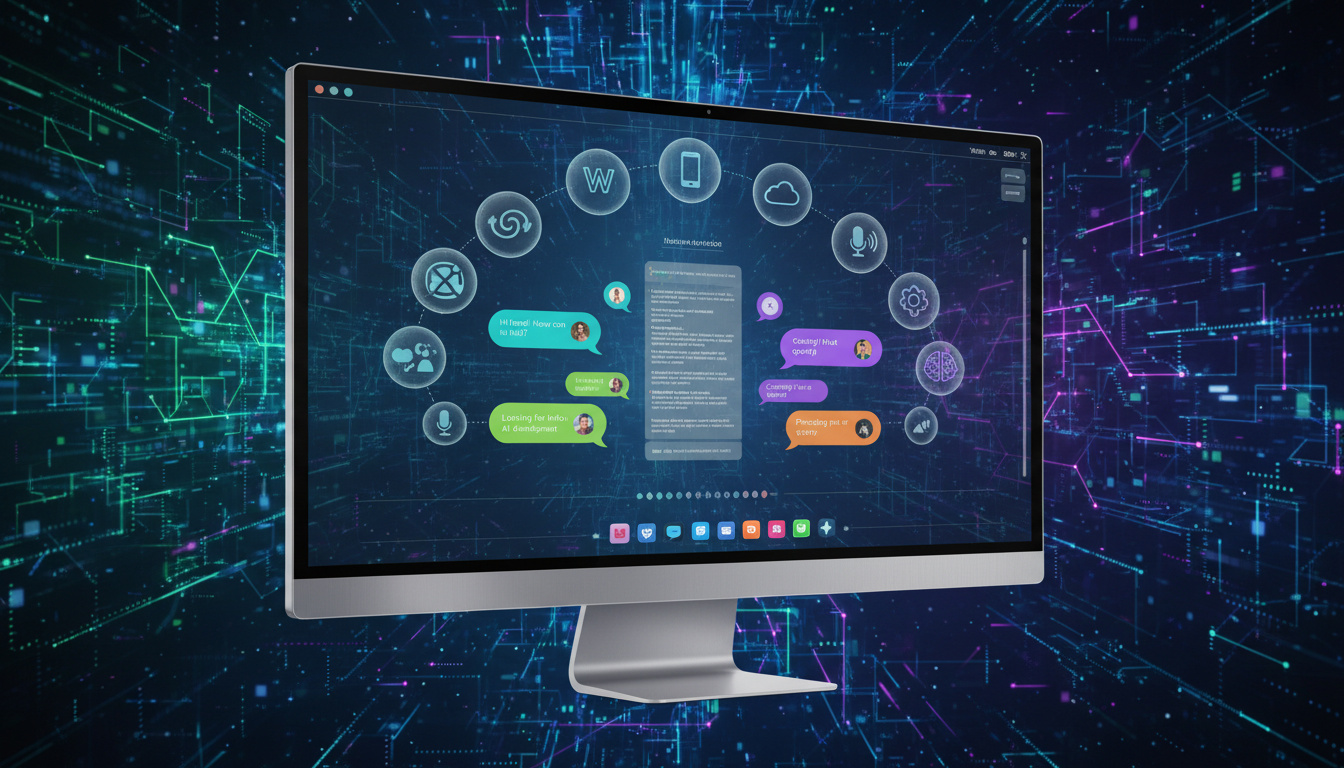
A chatbot is a computer program designed to simulate conversation with human users through text, speech, or other interfaces. These systems range from simple scripted responders to advanced artificial intelligence capable of generating human-like dialogue, often employing natural language processing and machine learning techniques.
Originally conceived as experimental tools for exploring machine intelligence, chatbots have evolved into essential infrastructure for customer service, automation, and information retrieval. Wikipedia traces their origins to the mid-20th century, while Britannica notes their widespread availability by the early 2020s.
This guide examines what defines a chatbot, how these systems function, their various classifications, and their trajectory from laboratory curiosity to ubiquitous technology.
What Is a Chatbot?
AI-powered conversational agent
ELIZA (1966)
NLP, ML, rule-based scripts
ChatGPT, Google Assistant
- Joseph Weizenbaum’s ELIZA, developed at MIT in 1966, established the foundational pattern-matching approach still referenced today.
- Systems fundamentally divide into rule-based architectures and AI-driven models, each serving distinct operational requirements.
- Natural language processing and machine learning form the technical backbone of modern implementations.
- OpenAI’s ChatGPT, launched in 2021, marked the transition to large language model dominance in conversational AI.
- Virtual assistants such as Siri and Alexa represent the integration of chatbot technology with broader automation ecosystems.
- Academic research indicates a significant surge in chatbot development and study following 2016.
- Precise market projections for 2025 remain unspecified in current research literature.
| Fact | Details |
|---|---|
| Origin | ELIZA by Joseph Weizenbaum at MIT, 1966 |
| Core Function | Simulate human conversation via text or speech |
| Input Methods | Text, voice, graphical interfaces |
| Primary Technologies | Natural language processing, machine learning, scripted rules |
| Architecture Types | Rule-based and AI-powered generative systems |
| Industry Milestone | ChatGPT launch signaling LLM era, 2021 |
| Market Data | No specific 2025 statistics available |
How Do Chatbots Work?
Processing User Input
Chatbots begin by parsing user inputs to identify intent. Early systems like ELIZA utilized simple pattern matching and keyword recognition. Contemporary implementations employ sophisticated natural language processing to analyze semantics and context, enabling more nuanced understanding of user requests.
Generating Responses
Response mechanisms vary by architecture. Rule-based systems select from predefined scripts or database entries. Research published in PMC identifies three primary generation methods: scripted rules, retrieval from existing datasets, and generative creation using AI models trained on vast corpora.
Technical Infrastructure
Modern chatbots rely on machine learning algorithms and linguistic processing frameworks. IBM’s technical documentation emphasizes how these systems require extensive training data to achieve human-like output quality.
Contemporary systems analyze not just keywords but semantic intent, using vector representations of language to understand context beyond literal text matching.
Retrieval-based systems quote existing content, while generative models like ChatGPT construct novel responses based on learned patterns, creating fundamentally different user experiences.
What Are the Main Types of Chatbots?
Task-Based and Rule-Based Systems
Declarative chatbots perform specific functions such as answering FAQs or processing bookings. These systems operate through predetermined patterns and scripted responses. Coursera categorizes these as single-function, rule-driven implementations suitable for narrow use cases.
AI-Powered and Generative Models
Predictive chatbots utilize machine learning and generative AI for flexible, context-aware interactions. These systems create new responses rather than selecting from fixed databases, enabling more natural conversation flows.
Virtual Agents and Assistants
Virtual assistants represent the most sophisticated tier, integrating chatbot capabilities with robotic process automation. Examples include IBM watsonx Assistant, capable of handling multi-step tasks across enterprise systems.
Popular Chatbot Examples
The landscape includes historical milestones and contemporary implementations. ELIZA (1966) simulated psychotherapy through pattern matching. A.L.I.C.E. (1995) introduced AIML markup for pattern-based replies. SmarterChild (2001) provided early utility on instant messaging platforms.
Contemporary examples include ChatGPT for text generation, and virtual assistants like Siri, Alexa, and Google Assistant. Historical documentation traces the evolution from ELIZA’s simple scripts to Dr. Sbaitso’s voice capabilities (1992) and Cleverbot’s learning mechanisms (1997/2008).
While ChatGPT generates human-like text, it operates as a predictive model without genuine understanding or consciousness, consistent with the “weak AI” classification of earlier systems like A.L.I.C.E.
History and Evolution of Chatbots
- : Alan Turing proposes the Turing Test for machine intelligence.
- : Joseph Weizenbaum creates ELIZA at MIT, the first recognized chatbot using pattern recognition.
- : CYRUS employs case-based reasoning for news data analysis.
- : Racter offers interactive text-based conversation.
- : Rollo Carpenter develops Jabberwacky, focusing on contextual pattern matching.
- : Dr. Sbaitso introduces voice-based interaction for MS-DOS systems.
- : A.L.I.C.E. utilizes AIML markup for pattern-based responses.
- : Cleverbot emerges from Jabberwacky, incorporating learning from user interactions.
- : SmarterChild launches on AOL and MSN messengers.
- : WeChat introduces chatbot integration in China.
- : Apple releases Siri (2011), followed by Alexa, Cortana, and Google Assistant.
- : Research and industrial application experience rapid growth.
- : OpenAI releases ChatGPT, entering the large language model era.
What Do We Know for Certain About Chatbots?
| Established Information | Remaining Uncertainties |
|---|---|
| ELIZA (1966) was the first recognized chatbot | Precise market valuation for 2025 |
| Two primary categories: rule-based and AI-powered | Long-term societal impact of generative chatbots |
| ChatGPT launched in 2021 | Specific adoption rates across all industries |
| NLP and ML are core technologies | Regulatory frameworks for autonomous chatbot actions |
| Research interest surged post-2016 | Timeline for true multimodal dominance |
Why Chatbots Matter Today
Chatbots now automate customer support, booking systems, and information retrieval, operating continuously without human fatigue. They scale conversation volume beyond human staffing limits while integrating with existing applications and messaging platforms. For additional context on automated systems and digital infrastructure, see 101 USD to CAD – Live Rate Equals 140.58 CAD.
The technology bridges simple scripted tools and complex autonomous agents. While early systems like ELIZA offered scripted therapeutic dialogue, modern implementations handle transactions, content generation, and multi-step workflows.
Expert Perspectives and Sources
ELIZA pioneered pattern matching but lacked true understanding, establishing foundational concepts for natural language processing and artificial intelligence research.
Historical analysis, Wikipedia and Britannica
Chatbots parse user inputs via natural language processing to understand intent, then generate responses through rule-based scripts, database retrieval, or generative AI models.
Technical documentation, IBM and Coursera
Key Takeaways on Chatbots
Chatbots function as computer programs simulating human conversation, evolving from 1960s pattern-matching experiments to today’s AI-driven language models. Organizations currently utilize these systems for automation and customer engagement, though specific future market trajectories remain undefined. For related technology perspectives, see 101 USD to CAD – Live Rate Equals 140.58 CAD.
Frequently Asked Questions
What is the difference between a chatbot and an AI?
A chatbot is a specific application that may or may not use AI. Rule-based chatbots operate on scripts without artificial intelligence, while AI chatbots employ machine learning and natural language processing for dynamic responses.
Are chatbots the same as virtual assistants?
Virtual assistants represent an advanced subset of chatbots. While basic chatbots handle single-step conversations, virtual assistants like Siri or Alexa integrate additional automation capabilities and can execute complex multi-step tasks across systems.
What are rule-based chatbots?
Rule-based chatbots rely on predefined patterns, keyword matching, and scripted responses. They follow decision trees to select appropriate replies from a fixed database rather than generating novel content.
Is ChatGPT a chatbot?
Yes. ChatGPT is a generative AI chatbot developed by OpenAI, launched in 2021. It uses large language models to create human-like text responses rather than selecting from pre-written scripts.
How to build a chatbot?
Simple rule-based chatbots require defining patterns and scripts, potentially using markup languages like AIML. AI versions require training large language models with natural language processing and machine learning techniques, often utilizing platforms like IBM watsonx.
What are chatbots used for?
Common applications include customer service automation, appointment scheduling, FAQ handling, information retrieval, and task completion. They provide 24/7 availability and scale beyond human conversation limits.
What is the future of chatbots?
Development trends indicate movement toward multimodal capabilities combining text, voice, and images, alongside agentic AI that can perform autonomous actions. Integration with large language models continues to expand.
Related stories




Hannah Walsh covers municipal government, city hall, councils, transit and local services across Canada.