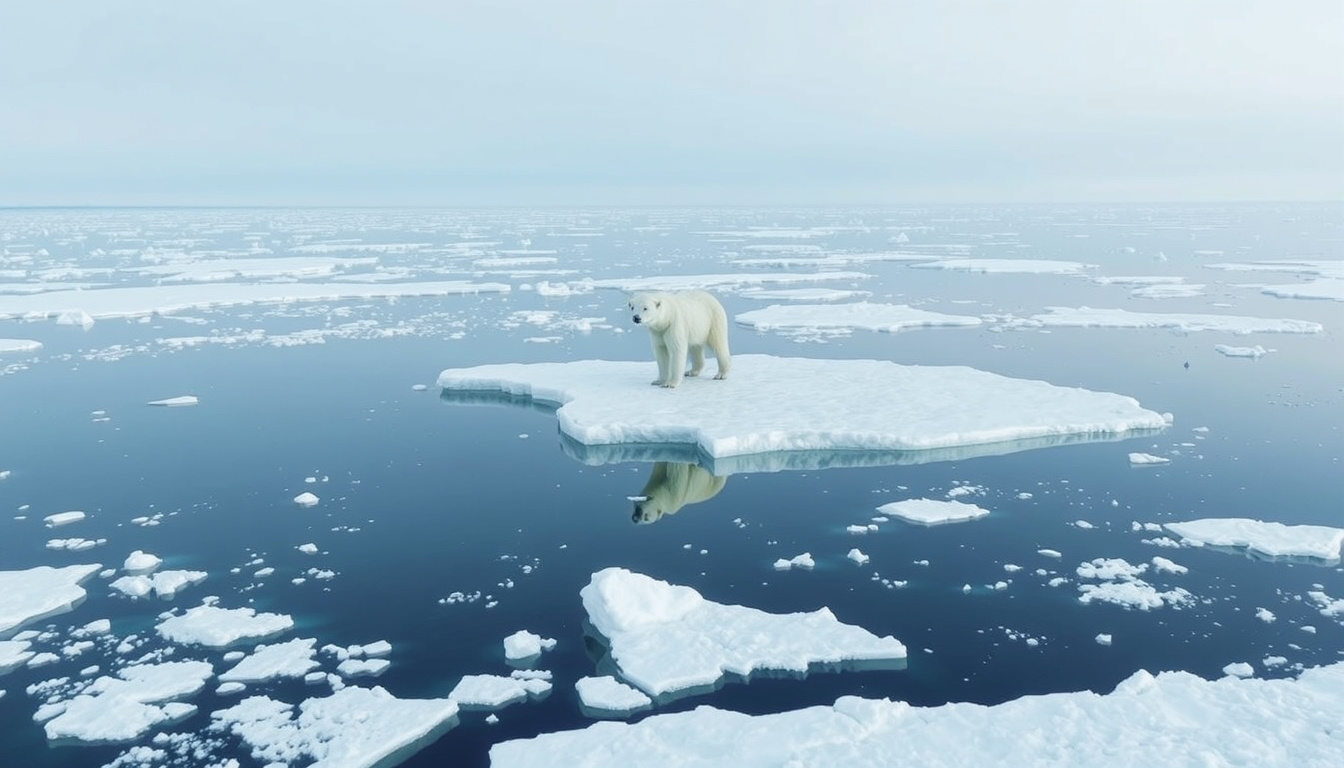

There’s something about a polar bear that stops you mid-scroll—partly the size, partly the fact that they thrive where few other mammals can, yet as the Arctic warms at nearly four times the global rate, these animals are living on increasingly thin ice—literally. This guide brings together the latest data on polar bear populations, habitat, and the conservation efforts working to secure their future.
Adult male weight: 300–800 kg ·
Global population estimate: 20,000–26,000 ·
Recognized subpopulations: 19 ·
Primary habitat: Arctic sea ice ·
Country with most polar bears: Canada (~60%) ·
IUCN Red List status: Vulnerable
Quick snapshot
- Largest land carnivore (Government of Canada)
- Found only in the Arctic (Polar Bears International)
- Adult males can weigh 800 kg (Government of Canada) (Government of Canada)
- Primary prey: seals (WWF)
- Exact population trends for many subpopulations remain uncertain due to data gaps (Polar Bears International)
- Future impact of sea ice loss beyond 2050 is still modeled, not fully observed (Polar Bears International)
- 1973: Agreement on Conservation of Polar Bears signed (Polar Bears International)
- 2011: Canada lists polar bears as Special Concern under SARA (Government of Canada)
- 2015: Circumpolar Action Plan adopted (Polar Bears International)
- Continued implementation of the 2015 Circumpolar Action Plan through 2025 (Polar Bears International)
- Renewed international commitments likely needed as sea ice declines accelerate (Government of Canada)
Polar bears are built for a life on ice—literally. Their size, fur, and swimming ability are all adaptations to a habitat that is disappearing three times faster than the global average.
Six key data points, one pattern: polar bears are built for extremes, from their massive size to their surprising swimming endurance.
| Attribute | Value |
|---|---|
| Scientific name | Ursus maritimus (Government of Canada) |
| Average male length | 2.4–3 m (7.9–9.8 ft) (National Geographic) |
| Top speed (land) | 40 km/h (25 mph) (Government of Canada) |
| Swimming distance record | Over 600 km (370 mi) (Canadian Science Publishing, peer-reviewed research) |
| Cubs per litter | Typically 1–2 (Polar Bears International) |
| Gestation period | About 8 months (including delayed implantation) (Government of Canada) |
What are 5 facts about polar bears?
How big are polar bears?
- Polar bears are the largest land carnivores, with adult males weighing between 300 and 800 kg (Government of Canada).
- They measure 2.4–3 meters in length, standing up to 1.5 meters at the shoulder (National Geographic).
What do polar bears eat?
- Their primary prey is ringed and bearded seals, which they hunt from sea ice (Canadian Science Publishing).
- They are opportunistic feeders and may also consume bird eggs, vegetation, and carrion when seals are scarce (WWF).
How long do polar bears live?
- In the wild, polar bears typically live 15–18 years, though some individuals reach their mid-20s (Polar Bears International).
- In captivity, lifespans can exceed 30 years (IUCN Red List).
The implication: Size and diet are tightly linked—their massive frame requires high-fat prey, and that prey depends on stable sea ice. As ice diminishes, so do their feeding opportunities.
Are polar bears Arctic or Antarctic?
Where do polar bears live?
- Polar bears inhabit the Arctic region, including Canada, Alaska (USA), Greenland, Russia, and Norway (Svalbard) (Government of Canada).
- They are found on sea ice, not on land year-round, making them a marine mammal (Polar Bears International).
Why don’t polar bears live in Antarctica?
- Polar bears evolved in the Arctic and have never been native to Antarctica (Canadian Science Publishing).
- Antarctica has no terrestrial predators like polar bears; seals there evolved without such threats (Polar Bears International).
What this means: Geographic isolation is a key part of polar bear identity. Their entire life cycle—from mating to denning to hunting—is tied to Arctic sea ice, a habitat with no equivalent down south.
Which country has the most polar bears?
How many polar bears are in Canada?
- Canada is home to approximately 16,000 polar bears, representing about 60% of the global population (Government of Canada).
- The global population is estimated between 20,000 and 26,000 individuals (Government of Canada).
Polar bear subpopulations in Canada
Canada manages 13 of the 19 worldwide subpopulations (Polar Bears International). These subpopulations are monitored under joint management agreements that combine scientific advice with Aboriginal Traditional Knowledge (Government of Canada).
Why this matters: Canada carries the bulk of responsibility for polar bear conservation globally. Its management decisions—on harvest quotas, protected areas, and climate policy—ripple across the entire species.
How many polar bears are left?
Are polar bears endangered?
- The IUCN Red List classifies polar bears as Vulnerable (IUCN Red List).
- In Canada, they are listed as a species of Special Concern under the Species at Risk Act (SARA) since November 2011 (Government of Canada).
- The main threat is sea ice loss due to climate change (Polar Bears International).
Polar bear population trends
Of the 19 subpopulations, some are stable, some are declining, and others have insufficient data to draw conclusions (Government of Canada). A 2011 peer-reviewed review highlighted the need for continued monitoring, especially for data-deficient subpopulations (Canadian Science Publishing). The future trajectory depends largely on how much sea ice remains in coming decades.
The catch: “Vulnerable” does not mean “doomed”—some subpopulations are holding steady. But the trend line bends with the temperature curve, and each fraction of a degree of warming narrows the margin.
What is the biggest killer of polar bears?
What eats a polar bear?
- Adult polar bears have no natural predators (Polar Bears International).
- Rarely, killer whales or walruses may attack cubs (Canadian Science Publishing).
Are polar bears aggressive?
- Polar bears are powerful predators and can be dangerous to humans, especially when food-stressed or defending cubs (Government of Canada).
- Encounters are rare but have increased as sea ice shrinks and bears spend more time on land (Polar Bears International).
The biggest long-term threat is climate-driven sea ice loss, which reduces access to seals (Polar Bears International). Direct human-caused mortality includes subsistence hunting in Canada (about 300 bears annually are harvested from the Canadian population) and conflict kills (Government of Canada). Starvation due to lack of hunting opportunities is a growing cause of death, particularly for subadults (Canadian Science Publishing).
The trade-off: Conservation measures like hunting quotas are sustainable under current conditions, but they are dwarfed by the existential threat of habitat loss. Managing bears on land does not solve the ice problem.
The next decade will determine whether international conservation frameworks can keep pace with ice loss. Canada alone cannot reverse climate change, but its protected areas and harvest management are critical stopgaps.
Expert perspectives
“Sea ice is essential for polar bears to hunt seals. As the ice retreats earlier each spring, bears are forced ashore with less fat reserves, leading to lower cub survival and increased human-bear conflicts.”
— Geoffrey York, Senior Polar Bear Scientist, Polar Bears International
“Canada’s subpopulation monitoring is world-class, but we still have data gaps for remote areas. The circumpolar action plan aims to fill those gaps with collaborative research.”
— Dr. Kristin Laidre, Polar Bear Researcher and Consultant to WWF
What we know and what remains uncertain
Confirmed facts
- Polar bears are marine mammals (Government of Canada).
- They are classified as Vulnerable by IUCN (IUCN Red List).
- Canada hosts most of the global population (Government of Canada).
What’s unclear
- Exact population trends for many subpopulations are uncertain due to data gaps (Polar Bears International).
- The future impact of sea ice loss beyond 2050 remains modeled, not fully observed (Polar Bears International).
- The exact number of polar bears in Russia and Greenland is not precisely known due to logistical challenges in surveying remote ice (Polar Bears International).
For Canada, which holds the world’s largest polar bear population, the choice is clear: reduce greenhouse gas emissions and protect critical sea ice habitat, or watch the bears face a future without ice.
biologicaldiversity.org, en.wikipedia.org, worldwildlife.org, pmel.noaa.gov, nathab.com
Frequently asked questions
How fast can polar bears swim?
Polar bears can swim at speeds of about 10 km/h (6 mph) and have been recorded covering over 600 km in a single swim (Canadian Science Publishing).
Why do polar bears have white fur?
Their fur appears white because each hollow hair scatters and reflects visible light, camouflaging them against snow and ice (Polar Bears International). Underneath, their skin is black to absorb heat.
Do polar bears hibernate?
Only pregnant females hibernate—in dens they dig into snow banks—during winter. Other polar bears remain active year-round (Government of Canada).
How far can a polar bear smell a seal?
A polar bear can detect a seal’s breathing hole from up to 1.6 km (1 mile) away or a seal under 1 m of snow (Polar Bears International).
Are polar bears related to grizzly bears?
Yes, polar bears and grizzly bears (brown bears) share a common ancestor and can interbreed, producing fertile hybrids known as “grolar” or “pizzly” bears (Canadian Science Publishing).
What is the difference between a polar bear and a grizzly bear?
Polar bears are larger, with longer necks and smaller ears adapted for swimming and hunting on sea ice. Grizzly bears have a prominent shoulder hump and more varied diet (Polar Bears International).
Related stories





Kevin Sullivan covers community events, neighbourhoods and local culture across Canada.