Niki de Saint Phalle: Pioneering Sculptor of Nanas and Beyond
Niki de Saint Phalle (born Catherine Marie-Agnès Fal de Saint Phalle, October 29, 1930, in Neuilly-sur-Seine, France – May 21, 2002, in La Jolla, California) was a French-American sculptor, painter, filmmaker, and author whose vibrant, monumental works explored themes of femininity, trauma, joy, and social commentary. As one of the few female monumental sculptors to achieve international recognition, she developed innovative artistic techniques that challenged conventions and captivated audiences worldwide.
Her career spanned several decades and mediums, from experimental shooting paintings to large-scale public installations. Saint Phalle gained fame through her signature Tirs (shooting paintings), her whimsical Nanas sculptures, and ambitious projects like the Tarot Garden in Tuscany. Her work continues to influence contemporary art, particularly in the realm of public sculpture and feminist art practice.
What are Niki de Saint Phalle’s Nanas?
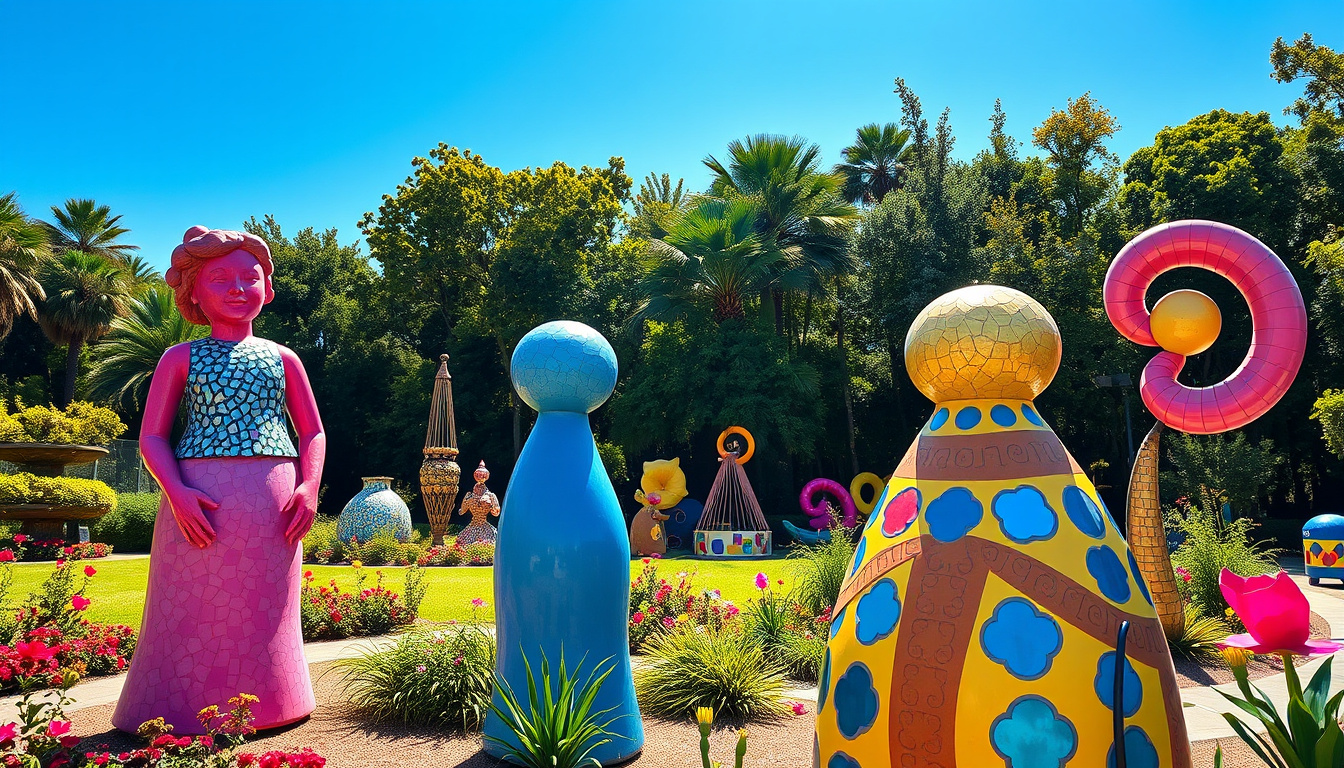
The Nanas represent Saint Phalle’s most recognizable and beloved contribution to contemporary art. These joyful, voluptuous female figures—often house-sized—were crafted from bright polyester and embodied themes of liberation, motherhood, and feminine energy. The term “Nana” derives from the French colloquial word for woman, and the sculptures quickly became cultural icons celebrating women’s strength and vitality.
Born 1930, France
Key style: Nanas
Died 2002
Monumental sculptures
Key insights about Niki de Saint Phalle:
- One of the few female monumental sculptors to achieve international acclaim
- Developed the Tirs (shooting paintings) technique in 1960–1961
- Created the iconic Nanas series beginning in 1962
- Only female member of the Nouveau réalisme movement
- Collaborated extensively with Swiss artist Jean Tinguely
- Designed the groundbreaking Hon-en-Paillettes installation
- Authored several illustrated memoirs and autobiographies
| Fact | Details |
|---|---|
| Full name | Catherine Marie-Agnès Fal de Saint Phalle |
| Birth/Death | October 29, 1930 – May 21, 2002 |
| Mediums | Sculpture, painting, filmmaking, writing |
| Notable series | Nanas, Tirs, The Bride, Tarot Garden |
| Spouses | Harry Mathews (m. 1948–1960), Jean Tinguely (m. 1971–1991) |
| Movement | Nouveau réalisme |
Origin of the Nanas
The Nanas emerged from Saint Phalle’s earlier confrontational reliefs depicting women giving birth, brides, dragons, and monsters. By 1962, she had distilled these themes into the cheerful, colorful figures that would define her legacy. These sculptures represented a turning point in how women’s bodies and experiences were represented in public art, prioritizing joy and abundance over traditional artistic conventions.
Iconic Nana examples
Among the most famous Nanas are those installed in public spaces across Europe and North America. The Tarot Garden in Tuscany houses numerous house-sized figures inspired by tarot cards, including The Empress, The Devil, and The Sun. The Stravinsky Fountain in Paris, created in collaboration with Jean Tinguely, features colorful kinetic elements honoring composer Igor Stravinsky.
Cultural impact
The Nanas transcended traditional museum boundaries, becoming beloved landmarks in parks and public squares worldwide. Their influence extends to fashion, advertising, and popular culture, where the celebration of diverse feminine forms has inspired subsequent generations of artists and designers. Saint Phalle’s work remains a reference point for discussions about public art and gender representation.
What is Niki de Saint Phalle’s most famous artwork?
While several works compete for the title of most famous, the Nanas collectively represent Saint Phalle’s greatest artistic achievement. However, specific installations like the Tarot Garden (1978–1998) and the groundbreaking Hon-en-Paillettes (1966–1972) hold particular significance in art historical contexts. The Tarot Garden, a 14-acre sculpture garden in Tuscany, stands as her most comprehensive project, featuring massive figures inspired by tarot imagery.
Shooting Paintings (Tirs)
The Tirs technique revolutionized Saint Phalle’s artistic practice and launched her career internationally. These assemblages combined plaster, paint-filled bags, and various objects that were shot with a rifle, causing dramatic colorful explosions. First performed publicly at the Moderna Museet in Stockholm in 1960–1961, the performances were visceral events combining performance art with artistic creation.
The Tirs technique debuted at the Moderna Museet in Stockholm in 1961, marking Saint Phalle’s breakthrough moment and establishing her reputation as an innovator willing to challenge artistic conventions through unconventional methods.
Hon-en-Paillettes
Hon-en-Paillettes (She Who Has a Hot Tail), created for the Moderna Museet in Stockholm between 1966 and 1972, represents one of Saint Phalle’s most ambitious installations. This monumental sculpture of a pregnant woman lying on her back allowed visitors to enter through her vagina, creating an immersive experience that explored themes of birth, femininity, and bodily autonomy. The work challenged conventional boundaries between viewer and artwork.
Key sculptures
Beyond the Nanas, Saint Phalle created numerous significant works. The Bride series (1960s) featured recurring monumental brides symbolizing both femininity and trauma. Cyclop (1987–1991) in Milly-la-Forêt, France, represents a collaboration with Jean Tinguely—a giant head decorated with mirror mosaics. Other notable works include Golem (1972, Jerusalem park for children), the Château Chinon Fountain (1988, commissioned by President Mitterrand), and the unbuilt Le Temple Idéal (1991 model for Nîmes).
What books and films did Niki de Saint Phalle create?
Saint Phalle expanded her artistic practice beyond sculpture to include writing and filmmaking, creating colorful, hand-illustrated books that documented her life and artistic vision. These works provide personal insights into her creative process, traumatic childhood experiences, and philosophical outlook on art and life.
Illustrated books
Mon Secret (1994), published in French, contains Saint Phalle’s memoirs revealing childhood abuse she suffered at the hands of her father. The candid account became significant for its direct confrontation of trauma and its implications for understanding her artistic themes. Traces (1999) followed as her English-language autobiography, further exploring her life journey and artistic development. Harry and Me: The Family Years 1950–1960 (2006, posthumous) documented her first marriage to Harry Mathews and the formative years of her artistic career.
Filmmaking career
Saint Phalle’s filmmaking career included Daddy (1973), a film exploring themes of paternal power and abuse that aligned with her autobiographical writing. She also created various performances and short films throughout her career, integrating her sculptural sensibilities with moving image storytelling. Her work in film demonstrated her commitment to exploring difficult personal themes across multiple artistic platforms.
Saint Phalle authored three major book works: Mon Secret (1994, memoirs), Traces (1999, autobiography), and Harry and Me (2006, posthumous). Her filmmaking included Daddy (1973) and various performances and short works.
What exhibitions feature Niki de Saint Phalle?
Saint Phalle exhibited widely from the 1960s onward, with major exhibitions at institutions including the Moderna Museet (1961), where she first performed the Tirs publicly. Her works have appeared in international retrospectives and continue to be featured in exhibitions exploring Nouveau réalisme, feminist art, and monumental sculpture.
Québec exhibition
The Musée national des beaux-arts du Québec has featured Saint Phalle’s work as part of its programming, highlighting her significance within North American collections. The museum’s exhibition approach has focused on her career spanning the 1980s and 1990s, providing regional audiences access to her monumental sculptures and exploring her connections to broader artistic movements.
Recent retrospectives
Contemporary retrospectives have examined Saint Phalle’s influence on public art and feminist practice. These exhibitions often highlight her pioneering role as one of the few female monumental sculptors and her innovative techniques that combined performance, sculpture, and social commentary. The ongoing interest in her work reflects growing attention to women’s contributions to art history.
Career Timeline
Niki de Saint Phalle’s artistic journey spanned more than four decades, marked by significant breakthroughs, collaborations, and the development of her signature visual language.
- 1930 – Born October 29 in Neuilly-sur-Seine, France, to a French banker father and American mother
- 1955 – Introduced to Jean Tinguely, beginning a pivotal artistic relationship
- 1960–1961 – Develops the Tirs (shooting paintings) technique; debut at Moderna Museet in Stockholm
- 1962 – Creates first Nanas; joins Nouveau réalisme movement as only female member
- 1966–1972 – Creates Hon-en-Paillettes installation for Moderna Museet
- 1971 – Marries Jean Tinguely
- 1978–1998 – Builds Tarot Garden in Tuscany, Italy
- 1983 – Creates Stravinsky Fountain in Paris with Tinguely
- 1987–1991 – Contributes to Cyclop monument in Milly-la-Forêt
- 2002 – Dies May 21 in La Jolla, California
What we know and what remains unclear
| Established information | Unclear or less documented aspects |
|---|---|
| Birth, death, and biographical milestones verified through multiple sources | Specific details about certain Québec exhibitions require further documentation |
| Artistic techniques (Tirs, Nanas) well-documented and exhibited internationally | Extent of perfume collaboration remains unclear from available sources |
| Major works (Tarot Garden, Stravinsky Fountain, Hon) thoroughly documented | Print editions pricing and market availability not fully catalogued |
| Marriages to Harry Mathews and Jean Tinguely verified | Details on “jeune” references to early career phase lack comprehensive documentation |
| Books and films documented through museum records and publications | Complete filmography beyond Daddy requires additional research |
| Role in Nouveau réalisme confirmed by movement records | Full extent of jewelry design work beyond GEM Montebello collaboration unclear |
Artistic context and legacy
Saint Phalle’s work emerged within the context of Nouveau réalisme, a movement founded in 1960 by Pierre Restany that emphasized new approaches to representing reality. Her inclusion as the movement’s only female member highlighted both her innovative approach and the gender imbalances of the postwar European art world. Her Tirs technique specifically challenged prevailing Abstract Expressionist practices by introducing performance, violence, and audience participation into the artistic process.
The Nanas represent a feminist intervention in public art, reclaiming feminine forms from traditional artistic representation. These cheerful, abundant figures contrast sharply with earlier artistic treatments of women as passive muses or idealized beauties. Saint Phalle’s work anticipated later feminist art movements while remaining accessible to general audiences through its humor and visual appeal.
Her legacy continues through her monumental works installed worldwide, ongoing exhibitions at major museums, and influence on contemporary artists working with public sculpture and feminist themes. The Tarot Garden remains a pilgrimage site for art enthusiasts, while her memoirs provide crucial documentation of her artistic philosophy and personal history.
Sources and perspectives
“Saint Phalle was one of the few female monumental sculptors to achieve international fame, known for her innovative techniques and vibrant, accessible works.”
“Her career was marked by experimentation with new materials and techniques, including the shooting paintings that established her reputation.”
Primary sources for Saint Phalle’s biography include her own writings (Mon Secret, Traces), institutional records from the Moderna Museet, MoMA, and the Musée national des beaux-arts du Québec, as well as contemporary accounts from major encyclopedic sources and art historical publications.
Summary
Niki de Saint Phalle stands as a pioneering figure in 20th-century art, whose innovative techniques—particularly the Tirs shooting paintings—and iconic Nanas sculptures established her among the most significant female monumental sculptors. Her career encompassed sculpture, painting, filmmaking, and writing, unified by a commitment to exploring femininity, trauma, and joy through accessible, visually striking works. Major achievements include the Tarot Garden in Tuscany, the Hon-en-Paillettes installation, and numerous public works across Europe and North America. Her influence continues through ongoing exhibitions, museum collections, and her lasting impact on public art and feminist artistic practice.
For those interested in exploring related topics, the AD designation in Canadian political contexts offers interesting parallels to how artistic movements establish their terminology.
Frequently Asked Questions
Is there a Niki de Saint Phalle perfume?
While Saint Phalle did design jewelry beginning in 1972 for GEM Montebello, documented perfume collaborations are limited in available sources. She created numerous other design works including ballet sets and public installations for children.
What are Niki de Saint Phalle prints?
Prints and editions of Saint Phalle’s work were produced through fabricators like Haligon from 1972 onward. These editions allowed broader distribution of her sculptural designs and contributed to her market presence.
What is Niki de Saint Phalle jeune?
“Jeune” is French for “young.” References to this term likely relate to Saint Phalle’s early career phase, when she was establishing her experimental artistic practice in the late 1950s and early 1960s.
What is the Nana Niki de Saint Phalle price range?
Original Nanas and major works command significant prices at auction and through galleries. Specific pricing varies considerably based on size, edition, provenance, and condition.
What is Hon Niki de Saint Phalle?
Hon-en-Paillettes (1966–1972) was a groundbreaking installation at the Moderna Museet featuring a monumental pregnant woman. Visitors could enter through her vagina, creating an immersive experience exploring birth and femininity.
What is Niki de Saint Phalle The Bride?
The Bride is a recurring motif in Saint Phalle’s work, appearing as monumental sculptures symbolizing both femininity and the complex emotions surrounding marriage and transformation.
What exhibitions feature Niki de Saint Phalle?
Saint Phalle’s work appears in major museum collections including MoMA, the Musée national des beaux-arts du Québec, and numerous international institutions. Recent retrospectives have examined her influence on public art and feminist practice.
What is Niki de Saint Phalle’s artistic style?
Saint Phalle’s style combines naïve, experimental approaches with monumental scale and vibrant colors. Her work is associated with Nouveau réalisme and characterized by playful forms, social commentary, and innovative techniques including performance elements.
Related stories




Marc Tremblay is Managing Editor at CanadaPerspective.org, running the daily news list, the publishing schedule and newsroom commissioning.