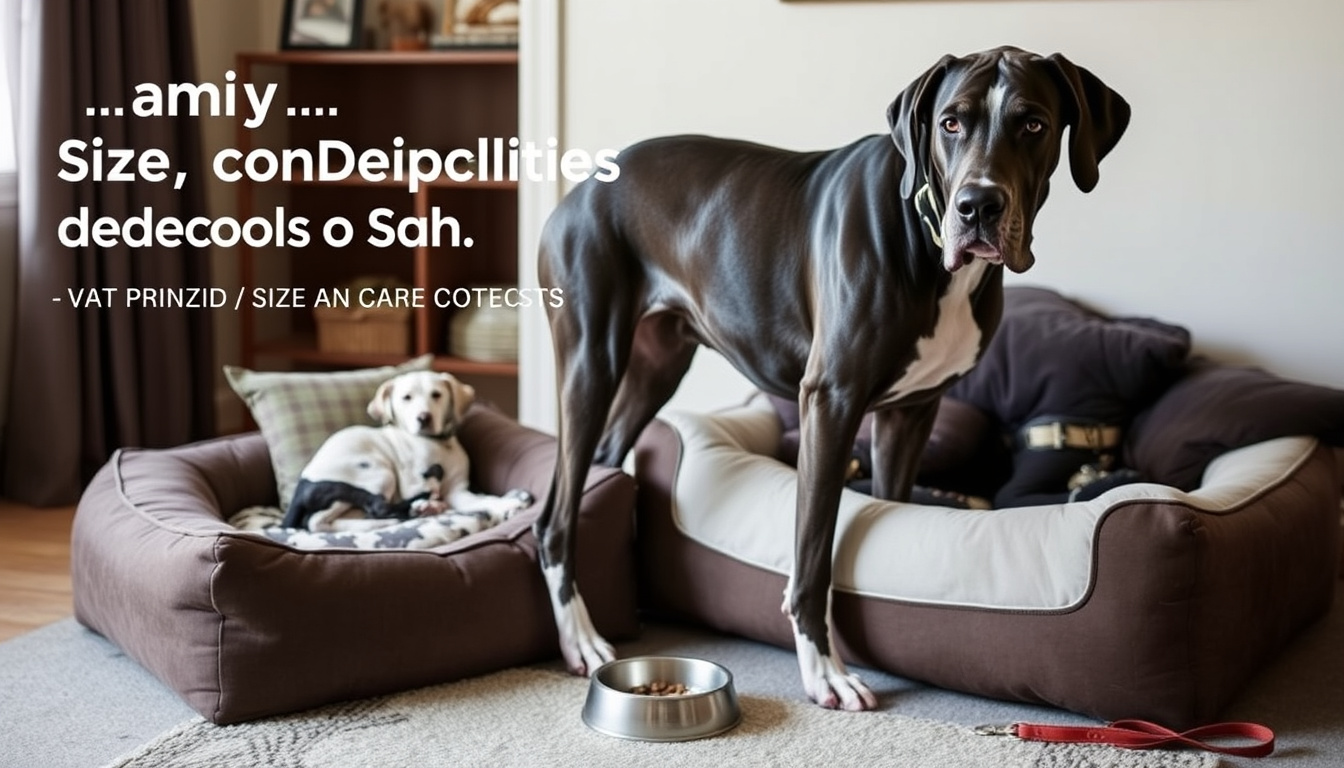

There’s something about a Great Dane that makes people stop and smile, but their towering size comes with real trade-offs. This guide lays out the facts on temperament, health, and cost to help you decide if one fits your home.
Height (male): 30–34 inches (0.76–0.86 m) ·
Weight (male): 140–175 pounds (63–79 kg) ·
Lifespan: 7–10 years ·
Origin: Germany ·
Temperament: Friendly, gentle, loyal
Quick snapshot
- Gentle and affectionate (American Kennel Club)
- Good with children when socialized (PetMD)
- May be reserved with strangers (The Kennel Club)
- Males 30–34 inches tall, 140–175 lbs (The Kennel Club)
- Need large indoor space and secure yard (American Kennel Club)
- Not ideal for apartments (general consensus) (The Kennel Club)
Nine key specs, one pattern: Great Danes demand space, health awareness, and a serious budget.
| Attribute | Value |
|---|---|
| Height (male) | 30–34 inches (0.76–0.86 m) (The Kennel Club) |
| Height (female) | 28–32 inches (0.71–0.81 m) (The Kennel Club) |
| Weight (male) | 140–175 pounds (63–79 kg) (The Kennel Club) |
| Weight (female) | 110–140 pounds (50–63 kg) (The Kennel Club) |
| Lifespan | 7–10 years (PetMD) |
| Temperament | Friendly, gentle, loyal (American Kennel Club) |
| Colors | Black, blue, brindle, fawn, harlequin, mantle (American Kennel Club) |
| Origin | Germany (American Kennel Club) |
| AKC Group | Working (American Kennel Club) |
Is a Great Dane a good family dog?
Temperament with Children
The American Kennel Club (official breed registry) describes Great Danes as sociable, friendly, and eager to please. That temperament, combined with patience, makes them natural companions for children when introduced early and consistently.
“The Great Dane is a gentle giant with a sweet, patient nature.”
American Kennel Club breed standard
Energy Levels
Despite their bulk, Great Danes have moderate energy. They need daily walks and playtime but are not hyperactive. Too little exercise can lead to destructive behavior, but they are not marathon runners. According to the American Kennel Club, they need human contact and affection just as much as physical activity.
Space Requirements
A Great Dane’s size (males stand 30–34 inches at the shoulder, per The Kennel Club) means they need room to stretch. A house with a fenced yard is ideal. Apartments can work with sufficient daily exercise, but the dog will feel cramped without regular outdoor access.
Families that provide structure and space get a devoted, gentle companion. Those who underestimate the square‑footage requirement may struggle with a restless 150‑pound dog.
Why is the Great Dane called the heartbreak breed?
Short Lifespan
The most direct reason is the breed’s short lifespan. PetMD (trusted veterinary resource) states the typical Great Dane life expectancy is seven to 10 years. That’s roughly half the lifespan of a small terrier or a toy breed. The bond formed in those years is deep, and the loss hits hard.
Common Health Issues
Great Danes are prone to several costly and serious conditions. VETX (pet health resource) lists bloat (gastric dilatation‑volvulus), dilated cardiomyopathy, and hip dysplasia as common. Bloat is a life‑threatening emergency that requires immediate surgery.
Emotional Impact
Owners often describe the experience as “heartbreaking” because the dog’s gentle personality makes the early goodbye especially painful. Insurify (insurance comparison site) also cites the 7–10 year average lifespan, reinforcing that this is a breed you cherish while you have them.
Veterinary experts recommend annual heart screenings and a bloat‑prevention feeding schedule. PetMD notes that larger doses of medications and higher food volumes add to the physical and emotional caretaking load.
What is the downside to owning a Great Dane?
High Food Costs
Feeding a Great Dane is expensive. PetMD explains that because of their size, they need far more food and larger medication doses than smaller dogs. Expect to spend $60–$100 monthly on quality kibble.
Health Problems
Beyond the life‑threatening conditions already noted, Great Danes frequently develop orthopedic issues. VETX reports hip dysplasia as a leading problem. Lemonade (pet insurer) warns that breed‑specific health issues drive up premiums and out‑of‑pocket costs.
Shorter Lifespan
As discussed, 7–10 years is the norm. That means owners face grief sooner than with almost any other large breed. Lemonade also cites this lifespan window when explaining insurance risk.
Training Challenges
A 150‑pound dog that hasn’t learned basic obedience is a handful. Positive reinforcement and consistency are key, especially during the giant puppy phase. The American Kennel Club emphasizes firm, consistent training.
What two breeds make up a Great Dane?
Historical Origins
The exact ancestral recipe is debated, but most evidence points to a cross between the English Mastiff and the Irish Wolfhound. The breed was developed in Germany for hunting large game such as boar and bear, a history that explains its size and courage. The American Kennel Club categorizes the Great Dane as a mastiff‑type breed with sighthound features.
Mastiff and Sighthound Ancestry
From the Mastiff side came the powerful frame; from the Wolfhound, the taller, leaner build. Modern Great Danes are classified in the AKC Working Group but still carry those ancestral traits. The Kennel Club (UK) provides a breed standard that describes these characteristics.
Despite the hunting heritage, the breed’s temperament today is gentle, not aggressive. The “dual ancestry” of power and speed was refined into a family companion.
Are Great Danes aggressive?
Temperament Basics
No. The prevailing reputation is that Great Danes are gentle giants. The American Kennel Club calls them “friendly, patient, and dependable.” Aggression is not a breed trait.
Socialization
Like any large breed, early socialization is critical. Without exposure to people, other dogs, and new environments, a Great Dane may develop fear‑based reactions. That isn’t aggression in the traditional sense—it’s a lack of social skills. Starting puppy classes between 8–16 weeks is crucial, as recommended by trainers.
Guarding Instincts
Great Danes can be protective of their home and family. This guarding instinct may be misinterpreted as aggression, but it’s typically a low‑key alert rather than unprovoked hostility. Proper training channels this instinct into calm vigilance.
Eight more specs in a single view: the full dimension and cost picture for Great Danes.
| Attribute | Value |
|---|---|
| Height (male) | 30–34 in (0.76–0.86 m) |
| Height (female) | 28–32 in (0.71–0.81 m) |
| Weight (male) | 140–175 lb (63–79 kg) |
| Weight (female) | 110–140 lb (50–63 kg) |
| Lifespan | 7–10 years |
| Temperament | Friendly, gentle, loyal |
| Colors | Black, blue, brindle, fawn, harlequin, mantle |
| Origin | Germany |
| AKC Group | Working |
| Coat type | Short, smooth, glossy |
| Exercise need | Moderate – 30–60 min daily |
Upsides
- Gentle, affectionate family companion (American Kennel Club)
- Moderate exercise needs, not hyperactive (AKC)
- Intelligent and eager to please (American Kennel Club)
- Low aggression when properly socialized (AKC breed standard)
Downsides
- Short lifespan (7–10 years) (PetMD)
- High food and medication costs (PetMD)
- Prone to bloat, hip dysplasia, heart disease (VETX)
- Require large indoor space and secure yard
- High pet insurance premiums – up to $267/month (MoneyGeek)
Confirmed facts
- Great Danes originated in Germany (American Kennel Club)
- Average lifespan is 7–10 years (PetMD)
- Males stand 30–34 inches at the shoulder (The Kennel Club)
- Require regular exercise and space (American Kennel Club)
What’s unclear
- Exact ancestral breeds (English Mastiff vs. Irish Wolfhound) are debated by historians.
- Whether aggression in some individuals is purely temperament or due to lack of training is not fully resolved.
- The optimal neuter age for Great Danes remains debated among breeders and veterinarians.
Expert perspectives
“Great Danes are sociable, friendly, and eager to please. They need firm, consistent training and lots of human companionship.”
American Kennel Club (official breed description)
“The typical Great Dane lifespan is seven to 10 years. Being a giant breed, they are more prone to bloat, joint issues, and heart conditions.”
Dr. Karen Becker, veterinary expert (via PetMD)
The decision to bring a Great Dane into your home is not about whether you like the breed—it’s about whether your life can absorb the weight of the commitment. For families with stable homes, a fenced yard, and a budget that accounts for $1,000+ in annual veterinary costs plus $60–$100 in monthly food, the Great Dane delivers a loyal, gentle presence that few breeds can match. For those without that margin, the heartbreak may start with the bank account long before the dog’s golden years.
youtube.com, walkinpets.com, caringhandsvet.com, petworks.com, petplace.com
Frequently asked questions
How much exercise does a Great Dane need?
About 30–60 minutes of moderate exercise daily. They enjoy walks and play but are not high‑energy.
What is the best diet for a Great Dane?
A large‑breed puppy formula until 18–24 months, then high‑quality adult large‑breed food. Avoid high‑fat diets to reduce bloat risk.
What health issues are common in Great Danes?
Bloat (GDV), dilated cardiomyopathy (DCM), hip dysplasia, and hypothyroidism are the most frequent concerns.
How much space does a Great Dane require?
A house with a fenced yard is ideal. Apartments can work with daily exercise but require commitment.
Are Great Danes easy to train?
They are intelligent and eager to please but require consistent, positive training from puppyhood.
Do Great Danes shed a lot?
Moderate shedding year‑round. Weekly brushing keeps hair under control.
What is the best age to neuter a Great Dane?
Many breeders recommend waiting until 18–24 months to allow full bone and joint development. Consult your vet.
Related stories





Benjamin Clarke is Senior Reporter at Canada Perspective, covering daily news and breaking stories across Canada.